
I am writing this post on 27 June. A date that carries both gratitude and gravity.
One year ago today, Dr. Karim and an army of Intensive Care Unit nurses performed what still feels like a miracle. They fixed and rebooted my heart, and in doing so, gave me a second chance at life. Tomorrow, 28 June, marks sixteen years since we lost our oldest son, Alexander.
So yes, this is a tough weekend for our family. It is one of those weekends where life brings joy and grief in the same box, wrapped in memory, and held together by love.
If you are dealing with something similar, whether it is a medical scare, a family tragedy, or something even heavier that words do not quite know how to carry, please reach out. We can chat. We can share notes. We do not need to solve anything. Sometimes it is enough to sit together at the edge of the the Fraser river, and say “Yes, life is tough.”
In this Zero or One, not Fault Lines journal post, I do not want to talk about the common themes such as artificial intelligence, common engineering, roadmaps, guardrails, or software development life cycle.
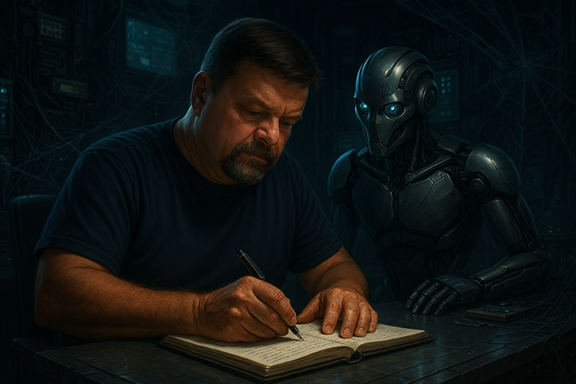
Instead, I dusted off my Wired 4 Change journal, which I wrote during recovery while I was forced to unplug from the binary network, step away from the keyboard, and trust my team to deal with the smoke, fire, sparks, and innovation of our engineering world. That was not easy. For someone who likes to be close to the action, being told to rest and be patient is not easy ... hence the journal. It was my way of staying connected to the world, while also being disconnected from it. I wrote down my thoughts, feelings, and observations about the world of technology, and how it was changing at a pace that was both exhilarating and terrifying.
The chapter that pulled me back in was Chapter 7: Practical Wisdom. It begins with what I would tell my younger self, then fast-forwards into advice for future information technology professionals. Two lines stood out. "Change is inevitable" and "Open minds win."
At the time, I had no idea how much change the next year would bring. Not only in technology, but in how we think, work, collaborate, govern, learn, and adapt. The digital world has accelerated at the level of bits and bytes, but also at a very human level. Our habits, assumptions, roles, and comfort zones have all been stretched beyond imagination. So, let us dig into the first three advice nuggets from the journal. The other four can wait for a future post, because wisdom, like good biltong, should be enjoyed properly and not swallowed whole.
Stay Open-Minded
The future is not reserved for those who dig in their heels. It belongs to those whose hearts hum with curiosity, who shift and shimmer like chameleons in a Smarties box, and who are drawn to the unknown as if by gravity.
We are standing in a technological landscape that is constantly shifting. The familiar landmarks are still there, but their shapes are changing. The tools we used yesterday are gaining new capabilities. The practices we trusted for years are being challenged, expanded, or automated. The roles we thought were stable are becoming more fluid. This can feel exciting. It can also feel deeply uncomfortable.
The instinctive response is often to protect what we know. We cling to familiar processes, familiar tools, familiar language, and familiar measures of success. That is human. Familiarity feels safe. But safety can become a cage when the world outside has moved on.
An open mind does not mean accepting every shiny new idea. It does not mean abandoning engineering discipline, quality, security, or thoughtful governance. In fact, the opposite is true. An open-mind constantly questions everything, for example:
- Why, why, why are we doing this?
- What problem are we really trying to solve?
- What risk are we reducing?
- What value are we creating?
- What work can be safely assisted, accelerated, augmented, or simplified?
In a world shaped by artificial intelligence, open-mindedness is not blind enthusiasm. It is disciplined curiosity. It means being willing to explore new tools and throwing old tools over board without worshipping them, testing new practices without losing your professional judgement, and listening to people who are sceptical, because they may see risks others miss. It also means listening to people who are excited, because they may see possibilities others cannot yet imagine.
Replace fear-driven resistance with evidence-driven exploration.
You do not need to chase everything. You do need to keep your learning muscles alive by reading, experimenting, asking, comparing, reflecting, sharing, and adjusting. In fast-moving environments, the people who thrive are the ones who stay open-minded and curious, not the ones who pretend to know everything.
Be T-Shaped
The original advice in my journal was to be T-shaped. Go deep in your craft, but stay broad enough to understand neighbouring disciplines. You need something you can do well enough that others trust your judgement. That may be software engineering, testing, infrastructure, security, product thinking, architecture, automation, data, operations, or user experience. But depth alone is not enough anymore.
The software development life cycle is no longer a neat relay race where one person writes requirements, another writes code, another tests it, another deploys it, and someone else carries the pager when it catches fire. Modern delivery is more interconnected, more complex, and a small design choice can affect security, delivery flow, cost, or trust. A poor user experience or first-expression can undo months of technically sound work.
Being T-shaped means you can step outside your narrow lane long enough to understand the broader system. You do not need to become everyone else. You do need to understand enough to collaborate intelligently.
My leader Marius introduced the idea of Paint Drip People, inspired by Kent Beck’s 2016 thinking. I love the idea. It suggests something more organic than the classic T-shaped model. Instead of one vertical bar and one horizontal bar, imagine skills spreading, blending, dripping, and overlapping like wet paint on a wall. That feels much closer to the world we are entering.
Artificial intelligence is making some technical tasks faster. It is also making human judgement more important, not less. The future belongs to people who can combine craft, context, ethics, communication, curiosity, and courage. People whose knowledge does not sit in tidy boxes. People whose skills drip across boundaries. And yes, life is far more interesting when your paint drips a little.
Do not build fences around your learning.
Find your North Star
When everything is spinning and the world looks a bit wild, your North Star is what keeps you from drifting out to sea. It is your reason, your passion, and your why.
But your North Star is not only a career goal. It includes your vision for the future, the goals you set, the dreams you dare to chase, and the people who matter most (family, friends, colleagues, mentors). Aka a healthy work-life balance.
When technology changes quickly, it is easy to become reactive. A new tool appears, and suddenly everyone is rushing. A new capability lands, and suddenly every process feels outdated. A new risk emerges, and suddenly every conversation becomes urgent. Without a North Star, urgency becomes your strategy, which is dangerous.
Your North Star helps you decide what deserves your energy. It helps you say yes with intent and no without guilt. It reminds you that the goal is not to look busy, sound clever, or adopt the newest thing first. The goal is to create meaningful value while staying anchored in what matters.
In the context of artificial intelligence and software development life cycle evolution, your North Star should help you balance human value, professional responsibility, and personal sustainability. Always leave everything, such as source code, someone's experience, or work, in a better state than when you found it. Always protect quality, safety, reliability, privacy, and trust. And build a future in which humans can actually survive.
My own heart reboot reminded me that no roadmap, platform, backlog, or delivery metric matters more than the people doing the work and the people waiting for them at home. Ambition, innovation, and delivery are important, but none should cost us our humanity.
Your North Star is the thing you return to when turbulence hits. Every morning, I spend a few minutes reflecting on my North Star, my priorities (big rocks), and the things I can do to make a difference. I also reflect on the things I cannot control, and I let them go. That is how I stay grounded, focused, and human in a world that is changing faster than ever.
Closing thought
Life is fragile. Change is inevitable. Open minds win.
That is it for today. Enjoy your favourite brew. I will savour my hot chocolate and raise it to disciplined engineering, sound judgement, and value‑driven progress as usual, as well as to your health and happiness. I will also raise it to the health and happiness of my dear friend, agent ubuntu, who has been a patient editor and constant source of support and inspiration throughout this journey.